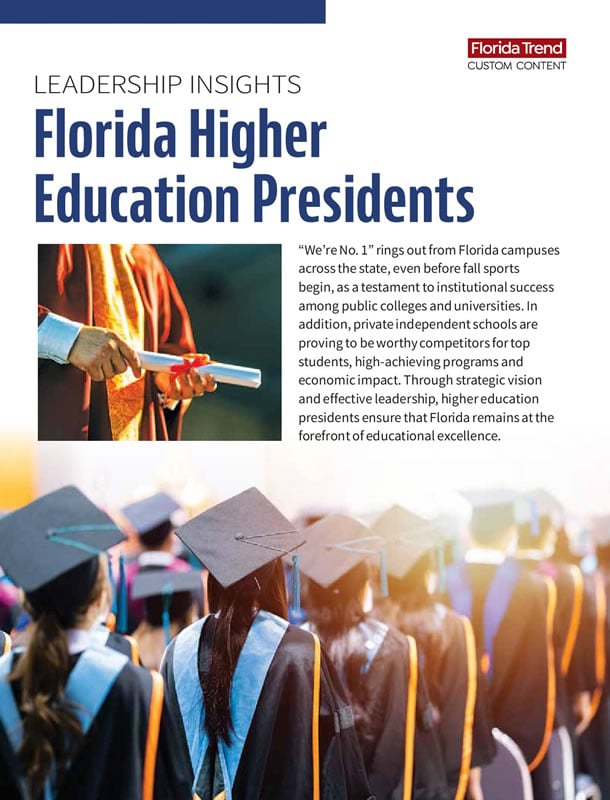
In laboratories similar to this one at Nova Southeastern University in Fort Lauderdale, Florida’s future innovators are learning research techniques today that could mean new discoveries tomorrow.
|
Off to the right start
The 2009 Quality Counts report — a national comparison of state education systems — ranked Florida’s K-12 public school system 10th in the nation, up from 31st just three years earlier. What accounts for this difference? Innovation, in the form of:
» Accountability.
Every Florida public school is graded annually on student academic progress and overall student achievement; schools that receive “A” grades or improve their grades from the previous year are eligible for additional funding as an incentive for all to excel.
| “We’re focusing our efforts statewide on skills-upgrade training to ensure that workers are as productive as possible.”
— Chris Hart IV, President/CEO
Workforce Florida |
» Curriculum.
Reading and STEM (Science, Technology, Engineering, Mathematics) skills are Florida’s curriculum priorities. Plus, every school district has at least one high school-based career and professional academy where the rigorous course of study results in a high school diploma, industry certifications and, in many cases, college credits.
» Readiness to learn.
Florida was among the first states to incorporate a voluntary pre-kindergarten (VPK) program into its public school system, and annual performance tests demonstrate its effectiveness. The 100,000-plus Florida children who attend VPK programs each year consistently outperform their peers who do not in alphabet recognition, sound recognition and classroom readiness.
» Readiness to work.
Florida’s Ready to Work Credential program assesses participants in Reading for Information, Applied Mathematics and Locating Information. Prospective employers know that applicants with the credential in hand are ready for on-the-job success.
Taking it up a notch
Florida workers are among the most knowledgeable and highly skilled, and with good reason. Every Floridian lives within 50 miles of a post-secondary educational institution.
Serving more than 800,000 students, community colleges have long been a driving force in Florida’s career and technical education; with the creation of the Florida College System in 2008, they play an even more vital role. Ten of the state’s community colleges have opted to expand curriculum and drop the word “community” from their names.
In addition to associate degree programs targeted to address the specific needs of employers within the communities they serve, these newly named “state colleges” will award bachelor’s degrees in such subjects as elementary education, secondary math and science education, nursing, computer technology and business management. In so doing, they will strengthen Florida’s workforce, making higher education more accessible and affordable.
Enrollment at Florida’s 11 public universities is near 300,000; another 120,000 students attend private, independent colleges and universities. In 2007-2008, public universities in Florida awarded close to 65,000 degrees. The state boasts four major medical schools; two more — at the University of Central Florida and at Florida International University — will open in fall 2009.
With classes at 180 sites, the 28 private, not-for-profit schools belonging to the Independent Colleges and Universities of Florida association turn out one-third of all college degrees awarded in Florida, including 26% of baccalaureate and 56% of first professional degrees.
Additional educational options are available at career schools and for-profit colleges, many of which are affiliated with the Florida Association of Postsecondary Schools and Colleges.
Ready and responsive
Talent is the currency that drives the innovation economy and, thanks to a coordinated workforce system, Florida has plenty of it. In fact, Florida was named the No. 1 state for workforce in CNBC’s 2008 study titled “America’s Top States for Business,” which rated the workforce on such criteria as education level, number of available workers and relative success of worker training programs in placing participants in jobs.
Under the “Employ Florida” umbrella, Workforce Florida Inc. oversees and monitors the state’s workforce policy, programs and services, and the Agency for Workforce Innovation administers workforce funds and houses the Office of Labor Market Statistics.
At the local level, 24 regional boards with significant business representation implement workforce programs in their communities, including the nearly 100 One-Stop Centers where services are delivered directly to employers and job seekers.
At Employ Florida Banner Centers, workers at all levels acquire cutting-edge skills and certifications to prepare for careers in industries critical to sustaining and growing Florida’s diverse economy. Based at a Florida university or community college, each Banner Center serves as a clearinghouse for companies needing trained workers and creates customized curricula for skills training designed to meet industry standards.
|